








Hydrolyzed fish collagen peptides vs Bovine Collagen
In today's rapidly expanding functional nutrition and oral beauty market, collagen has become a key ingredient for building core product competitiveness. Through in-depth discussions with global brands, R&D teams, and supply chain decision-makers, a recurring focal point has emerged: ‘Between hydrolysed fish collagen peptides and bovine collagen, how should my product make the choice?’ The answer to this question is never a simple either/or judgement, but rather a systematic decision concerning product positioning, formulation design, efficacy claims, and target markets. Different raw material pathways will directly guide products towards distinctly different commercial narratives and technical implementations.
This article will systematically outline the key distinctions between fish collagen and bovine collagen across four dimensions: raw material science, formulation compatibility, regulatory compliance thresholds, and market differentiation. This analysis will empower you to make precise, sustainable raw material strategic choices amidst increasingly competitive product categories.
I. Source Differences: Distinct Narratives from Sea and Land

Fish collagen protein primarily originates from the skin and scales of deep-sea fish such as cod and tilapia. This presents a noteworthy environmental advantage: the upcycling of fishery by-products. Statistics indicate that approximately 30% of global annual fish catches become by-products during processing, with collagen-rich fish skin and scales historically discarded. Today, advanced technologies transform these into high-value raw materials, aligning with circular economy principles.
-
Bovine collagen primarily originates from cattle bones, hides, and tendons. This relies on traditional livestock farming systems, where supply chain transparency and traceability are particularly crucial.
From a sustainability perspective, fish collagen holds a stronger environmental narrative. Many fish collagen sources certified by the Marine Stewardship Council (MSC) provide brands with robust “ocean-friendly” credentials.
II. Molecular Structure: Similar Components, Different ‘Languages’
Though both termed collagen, fish and bovine collagen exhibit subtle yet critical differences at the molecular level.
Dominance of Type I Collagen: Fish collagen contains over 90% Type I collagen, closely matching the composition ratio found in human skin. Bovine collagen, however, is typically a blend of Types I and III (roughly 4:1), with Type III collagen offering greater benefits for joint and vascular health.
Differences in Molecular Size: Thanks to gentler enzymatic hydrolysis processes, premium fish collagen yields a higher proportion of low-molecular-weight peptides. These ‘smaller’ peptides are more readily absorbed and utilised by the human body. A study published in the Journal of Medicinal Food demonstrated that collagen peptides with molecular weights below 3 kDa reached peak concentrations in the bloodstream within two hours of oral administration [1].
Owing to fish having lower body temperatures, their collagen triple-helix structure unravels at comparatively lower temperatures. This suggests it may exhibit superior solubility and bioactivity at human body temperature (37°C).
III. Formulation Performance: When Ingredients Meet Product

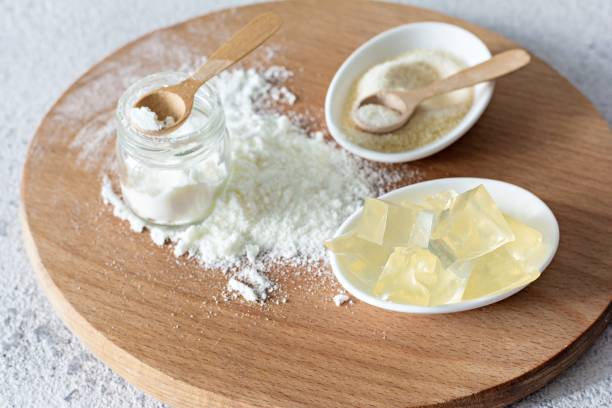
Solubility and Clarity: Hydrolysed fish collagen powder dissolves rapidly in cold water, forming a clear, transparent solution—crucial for developing transparent beverages or refreshing serums. Bovine collagen may require heating to dissolve completely, and the solution may exhibit a slight opalescence.
pH Adaptability Range: Fish collagen typically demonstrates greater stability when developing acidic formulations (such as fruit acid serums or vitamin C products). Our test data indicates that premium fish collagen maintains over 95% of its activity within a pH range of 3-10.
Flavour and Odour: This is a concern for many brands. While early fish collagen did present challenges with fishy odour, modern deodorisation techniques are now highly advanced. Through a four-stage deodorisation process (including enzyme-controlled hydrolysis and activated carbon adsorption), premium fish collagen powder can be rendered virtually odourless, ensuring it does not interfere with the flavour design of the end product.
IV. Safety and Compliance: Non-Negotiable “Hard Metrics”
-
Allergen Considerations: Fish collagen may pose risks to individuals with seafood allergies, whilst bovine collagen necessitates management of BSE (Bovine Spongiform Encephalopathy) risks. Selecting suppliers with comprehensive traceability systems and BSE/TSE (Transmissible Spongiform Encephalopathies) clearance declarations is paramount.
Religious and Dietary Compliance: This is an often underestimated yet highly influential factor. Fish collagen meets both Halal and Kosher certification requirements, while also being suitable for consumers who abstain from beef, such as those of the Hindu faith. This paves the way for products to enter diverse global markets.
V.FAQ
Q1. Is hydrolysed fish collagen necessarily more readily absorbed than bovine collagen?
A: Not entirely. Generally speaking, hydrolysed fish collagen possesses a lower molecular weight and more concentrated distribution, which to some extent facilitates human absorption. However, the actual absorption efficacy also depends on the hydrolysis process, peptide chain structure, intake dosage, and product formulation format, rather than solely on the raw material source.
Q2. Does fish collagen possess a noticeable fishy odour?
A: Early products indeed exhibited this issue. However, with advancements in enzymatic hydrolysis and deodorisation techniques, the aroma of high-quality hydrolysed fish collagen is now effectively controlled. In ready-to-drink products and functional beverages, provided the formulation is appropriately designed, it typically does not significantly impact the final taste profile.
Q3. Which collagen type is more suitable for oral beauty products?
A: From a market application perspective, hydrolysed fish collagen is more prevalent in oral beauty products. Key reasons include its smaller molecular weight, superior solubility, and higher proportion of Type I collagen. These characteristics align more readily with product concepts such as ‘skin health’ and ‘beauty nutrition’.
Q4. Is bovine collagen more suitable for joint and bone health products?
A: Yes. Bovine collagen is typically used in joint, bone, and sports nutrition products, particularly in formulations requiring higher addition levels where its stability and cost advantages are more pronounced. This is one reason it has long held a significant position in the traditional nutritional supplement market.
Q5. Can fish collagen and bovine collagen be used concurrently within the same formulation?
A: Yes. In practical formulations, some brands employ blended fish and bovine collagen to balance absorption characteristics, functional narratives, and cost structures. The key lies in clearly defining the primary selling point and rationally designing labelling and market communication logic.
Q6. Does fish collagen hold greater regulatory and market advantages?
A: In certain markets, fish collagen more readily fulfils Halal or Kosher requirements while mitigating potential consumer concerns regarding bovine-derived ingredients. However, specific regulatory compliance must be assessed against the requirements of the target market.
At Xi'an Le-Nutra Ingredients Inc, we not only supply high-purity fish collagen protein and bovine collagen, but are committed to becoming an extension of your R&D capabilities.
Choosing between fish or bovine sources involves no absolute ‘superiority’ or ‘inferiority’ – only suitability. Fish collagen supports premium brand narratives with high price points and perceived efficacy, while bovine collagen forms the robust foundation for mass-market, value-driven products.
Which category does your upcoming product fall into? Should you require guidance on selecting the optimal specifications (molecular weight, ash content, particle size) for your production line, our expert team stands ready to provide formulation data.
📚 References: