Leave Your Message
When it comes to beverage makers, they really care about protein that mixes smoothly, stays stable over time, and leaves a nice, pleasant finish. For protein peptides, solubility isn’t just a minor detail—it’s actually a pretty big deal. It affects how well the powder disperses, whether it settles at the bottom, the way it feels in your mouth, and how consistent the production process is. Even in a clear drink, just a tiny haze can make consumers think the quality’s been affected.
The market for these products is growing fast. According to Grand View Research, the global market for protein supplements hit around USD 24.3 billion in 2023, and it’s expected to grow at about 8% annually from 2024 through 2030. Now, I should clarify—this is a broad category, not specifically about beverage peptides. But still, it shows that there's a strong, sustained interest in protein-based nutrition. Little details really matter here—things like where the peptide comes from, its molecular weight distribution, pH levels, heat treatment, and mineral content—all can influence how well the peptide performs. A sample that dissolves quickly in the lab might still end up forming sediment after processing or just sitting on the shelf.
So, if you’re evaluating China Best Protein Peptides for Beverage Solubility, don’t just go by a vendor’s headline claim about solubility. Make sure to ask for detailed technical data, batch specifications, and application samples that are tested in the actual beverage system you’re working with. Remember, the solubility of protein peptides really depends on the whole recipe—not just the ingredient by itself. Developers of functional foods and beverages should compare how clear the drink is, how well it disperses, taste, and stability under real-world conditions. No single peptide fits every type of drink perfectly, and one test isn’t enough to draw conclusions. The key starting point? Look for solid, transparent evidence, and then do some trials to see both what works well and what doesn’t—that’s how you really find what’s best.
China Best Protein Peptides for Beverage Solubility
Protein peptides are short chains of amino acids, usually produced by breaking larger proteins into smaller pieces. Their size and composition affect how they behave in water. Many disperse more readily than intact proteins, making them useful in ready-to-mix drinks, clear beverages, and protein-enhanced juices. But “peptide” does not guarantee instant clarity. Some formulas still turn cloudy or form sediment.
In a beverage, peptides can add protein while influencing texture, taste, and stability. Their performance depends on the peptide profile and the drink’s conditions, including acidity, minerals, heat, and mixing order. A low-pH fruit drink, for example, may behave differently from a neutral milk-style drink. That sounds simple. It isn’t. Small formulation changes can alter the result, so test the finished recipe rather than relying on a solubility claim alone.
Tips: Mix a small sample using the intended water temperature and mixing time. Check for haze, foam, sediment, and flavor after standing overnight. If clarity matters, test at the beverage’s actual pH and mineral level. Record each adjustment; otherwise, a successful batch can be hard to repeat. Protein content, taste, and solubility may trade off, so choose based on the drink’s purpose.
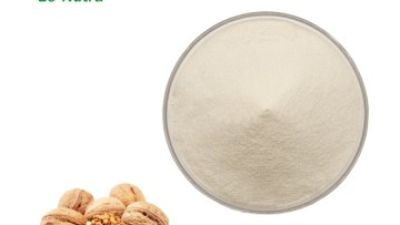
Hydrolyzed Walnut Protein Powder is a cosmetic-grade ingredient designed for skin care and hair care formulations. Its light yellow powder form is easy to incorporate into suitable products, and it dissolves in water to create a clear, transparent solution. With a protein content of at least 80% and an average molecular weight of 2,000 Da or less, it offers formulators a versatile option for creating lightweight, protein-enriched products. Customized molecular-weight specifications may also be available to suit different formulation needs.
In skin care, this walnut-derived protein can help support the skin barrier and provide moisturizing benefits, making it suitable for products focused on softness and hydration. In hair care, it can help improve the feel and strength of hair while providing protective conditioning. It may be used in a range of cosmetic formulations, such as lotions, creams, serums, shampoos, and conditioners, subject to compatibility and stability testing. Its clear aqueous solution can be useful when a formulation calls for a smooth appearance without visible particles. As with any cosmetic ingredient, the finished product should be evaluated for performance and suitability for its intended use.
Peptide size, electrical charge, and water-attracting or water-repelling regions all matter. Drink acidity, minerals, temperature, and mixing speed also change dispersion.
Not necessarily. Acid can change its charge and cause particles to gather, making citrus juice cloudy or leaving sediment.
Common sources include fish, bovine or porcine collagen, soy, and whey. The source alone does not predict clarity, taste, or stability.
Use the intended recipe and dosage. Record the pH, mixing time, temperature, appearance, and any sediment after storage.
Look for visible particles, haze, sediment, foam, and changes in taste or mouthfeel. A bitter or metallic aftertaste matters too.
Yes. Heating, storage, acidity, and contact with minerals can affect clarity over time. Check it again after storage.
Keep concentration, mixing speed, temperature, and observation time the same. Change one factor at a time and keep written records.
It is a useful start, not a final answer. Results may differ between batches and production equipment. One test can fool us.
Protein peptides are short protein fragments that can contribute nutrition and functional benefits to beverages. Their solubility depends on factors such as peptide size, amino acid composition, and the drink’s pH, temperature, mineral content, and processing conditions. Understanding Protein Peptide Solubility In Beverage Formulations helps developers anticipate clarity, sedimentation, texture, and stability across different beverage types.
Chinese manufacturers may produce peptides from sources such as milk, fish, soy, or other food proteins. When comparing options, assess dissolution speed, dispersibility, clarity, taste, and performance during storage and processing. Select a peptide suited to the beverage’s ingredients and intended characteristics, and evaluate it in the finished formulation. Sourcing decisions should also consider ingredient specifications, traceability, quality controls, safety documentation, production consistency, and dependable supply. These practical checks can help formulators balance beverage performance with nutritional and operational needs.