Leave Your Message
Curcumin has definitely caught the attention of the scientific community for quite some time. Still, it’s not without its issues—mainly, its poor water solubility and how quickly it gets metabolized, which make using it in real-world applications pretty tricky. Because of that, improving how our bodies can actually absorb curcumin—its bioavailability—is a big deal for researchers, formulators, and manufacturers who are serious about quality. But here’s the thing: just because your body takes in more curcumin doesn’t automatically mean you’ll see better clinical results. That’s something folks really need to keep in mind.
Bharat B. Aggarwal, a leading expert in curcumin research and a former professor at MD Anderson Cancer Center, once said, “Curcumin has been shown to be safe, effective, and affordable.” It’s encouraging, no doubt, but we still need solid, controlled evidence to back up any claims. In this article, we’re looking at ten different ways to boost curcumin’s bioavailability—things like combining it with piperine, using phospholipid complexes, creating micelles, nanoparticles, solid dispersions, and optimized emulsions. Each of these methods alters how curcumin behaves in some way.
And did you know? Manufacturing actually starts quite early in the process. Things like raw material quality, extraction temperature, particle size, and controlling oxidation can all impact how well the final product works later on. A good Curcumin Extraction Plant should keep track of things like botanical authenticity, solvent use, batch consistency, and testing for contaminants. Sometimes, those little details in the process matter more than the fancy marketing language.
Throughout this discussion, we’ll compare how different formulations enhance absorption, how complex they are to make, their stability and safety profiles, and whether they’re practical for large-scale production. We’ll also challenge some common assumptions—because increased plasma levels of curcumin don’t necessarily mean it will be biologically beneficial. Some promising lab results don’t always translate well into the real world, which is something to watch out for. To draw reliable conclusions, we need transparent testing, realistic dosage comparisons, and independent verification. Think of this overview as a helpful starting point, not the final word on the subject.
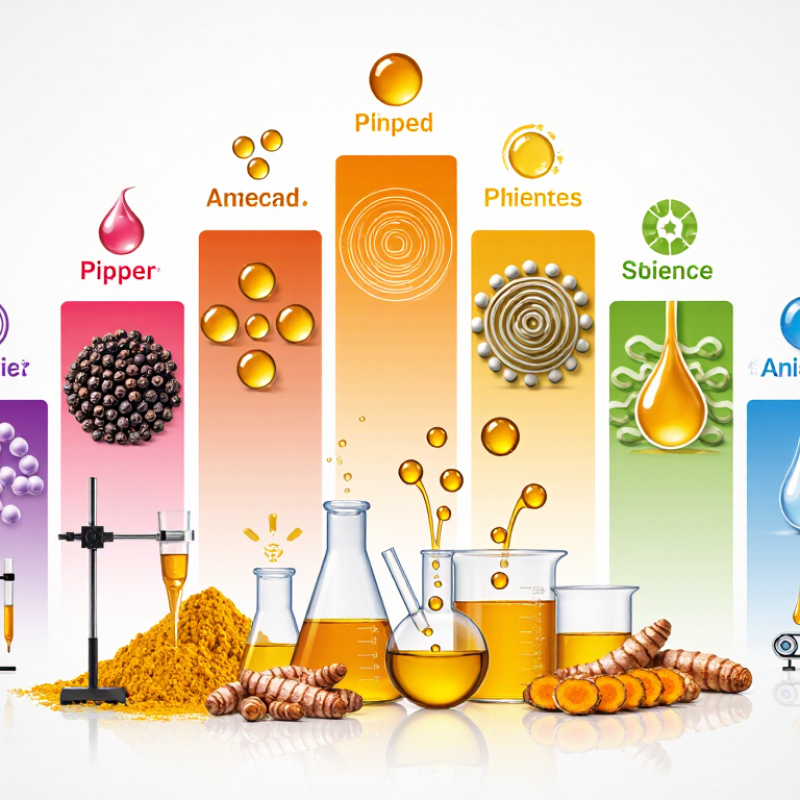
Top 10 Curcumin Bioavailability Improvement Methods
Curcumin absorption faces several biological barriers. It dissolves poorly in water, crosses the intestinal wall slowly, and undergoes rapid glucuronidation in the liver and gut. A pharmacokinetic study published in Planta Medica found that 2,000 milligrams of curcumin produced barely detectable blood levels. Adding piperine increased exposure by about 2,000 percent, but this result came from a small human trial. The number sounds impressive. The evidence is not equally strong for every user.
Modern delivery methods aim to improve these weak points. Lipid-based systems may support absorption with dietary fat. Phospholipid complexes, micelles, nanoparticles, cyclodextrins, and solid dispersions can improve dissolution. Sustained-release systems may reduce rapid clearance. Microbiome-focused approaches remain promising, yet human evidence is still developing. A 2023 review in Nutrients noted substantial variation among formulations, doses, and study designs. This makes direct product comparisons difficult. More absorption does not automatically mean better clinical outcomes.
Tips: Read the human pharmacokinetic data, not only “high absorption” claims. Take water-dispersible forms as directed. Fat-assisted forms may suit meals better. Check whether studies measured free curcumin or total metabolites. That distinction matters. Clinical trials often use short durations and small samples, so personal response can differ. A careful choice should consider formulation, dose, tolerability, and the condition being studied.
Curcumin has low water solubility and is rapidly metabolized and eliminated. The approaches below use different strategies to address these barriers; their effects vary by formulation, dose, and study conditions.
| No. | Method | How It May Help | Evidence Snapshot | Important Considerations |
|---|---|---|---|---|
| 1 | Piperine co-administration | Piperine can affect intestinal and hepatic metabolism, potentially slowing some pathways involved in curcumin clearance. | Human pharmacokinetic evidence exists, but findings from a specific combination do not apply to every product or dose. | Piperine may alter the absorption or metabolism of medicines. Seek professional advice if taking prescription drugs. |
| 2 | Phospholipid complexes | Binding curcumin with phospholipids can improve its dispersion and interaction with lipid membranes. | Human studies have evaluated particular phospholipid formulations; results are formulation-specific. | Complex composition and manufacturing can differ, so products should not be assumed equivalent. |
| 3 | Micellar delivery | Micelles can carry poorly water-soluble curcumin in a dispersed form, helping it mix with digestive fluids. | Human absorption studies are available for specific micellar preparations; outcomes cannot be generalized to all products. | Improved blood levels do not by themselves establish improved clinical outcomes. |
| 4 | Lipid-based carriers | Oils or other lipid carriers may help dissolve curcumin and support its incorporation into digestion-related lipid structures. | The approach is supported by formulation research; human results depend on the carrier and finished formulation. | “Oil-based” covers a range of formulations and does not guarantee a particular increase in absorption. |
| 5 | Turmeric volatile-oil combinations | Turmeric oils can be included in a formulation intended to influence curcumin dispersion, absorption, or metabolism. | Some specific combinations have been studied in people; evidence is not interchangeable across formulations. | Check the full ingredient list and consider allergies, tolerability, and possible medicine interactions. |
| 6 | Nanoemulsions | Small oil droplets can improve dispersion of curcumin in aqueous environments and increase the surface area available during digestion. | Promising formulation research exists, but evidence and performance depend on the specific system. | A small droplet size alone does not prove greater absorption or clinical benefit. |
| 7 | Particle-size reduction | Micronization or other milling methods can increase surface area and may improve dissolution. | The physical principle is well established; the effect on human curcumin exposure depends on formulation and testing. | Improved dissolution in a laboratory does not necessarily translate into a similar change in absorption in people. |
| 8 | Cyclodextrin inclusion complexes | Cyclodextrins can form complexes with poorly soluble compounds and may improve curcumin’s apparent water dispersibility. | Research supports improved solubility in some systems; evidence for human absorption is more limited. | Complex type, preparation, and dose can affect both performance and tolerability. |
| 9 | Polymeric nanoparticles | Polymer-based particles may protect curcumin and improve its dispersion or release characteristics. | Most evidence is from laboratory and preclinical research; human data are limited. | Results from experimental delivery systems should not be treated as proof of supplement effectiveness. |
| 10 | Solid lipid nanoparticles or nanostructured lipid carriers | Lipid particles can carry curcumin in a protected, dispersed form and may influence its release during digestion. | These are active research approaches, with much of the evidence coming from formulation and preclinical studies. | Human absorption and long-term outcome evidence should be assessed for each finished formulation. |
Note: This overview is informational, not medical advice. “Bioavailability” may refer to different measures, such as curcumin or its metabolites in blood, and study results can vary with dose, meal conditions, and analytical methods. Higher measured exposure does not necessarily mean greater health benefit.
Turmeric Extract Curcumin is gaining attention as a practical ingredient for functional foods and beverages. Industry research projects the global functional foods market to grow from approximately USD 281 billion in 2021 to more than USD 529 billion by 2028, reflecting strong consumer interest in products associated with wellness, immunity, and active lifestyles. Derived from *Curcuma longa L.*, this yellow-orange powder contains curcumin and other turmeric compounds, offering antioxidant and anti-inflammatory properties while supporting joint health and vitality. Its natural color also makes it suitable for nutrition drinks, dairy alternatives, instant beverages, functional snacks, and dietary formulations.
For beverage applications, curcumin extract can contribute a warm golden color and distinctive turmeric note. Formulators may select 65%, 90%, or 95% purity according to product positioning, dosage requirements, and processing conditions. As reported in global functional beverage market analyses, demand for beverages with added health-oriented ingredients continues to expand, particularly in sports nutrition, healthy aging, and everyday wellness categories. Appropriate dispersion technology and flavor balancing are important for achieving a smooth consumer experience.
The ingredient is also used in health care products and cosmetics for antioxidant, skin-brightening, and vitality-focused formulations. It is supplied in vacuum aluminum foil bags or 25 kg fiber drums with double food-grade inner bags. For quality preservation, the powder should remain sealed in a cool, dry place away from sunlight, heat, and humidity. Under recommended storage conditions, its typical shelf life is 24 months.
It dissolves poorly in water and the body processes it quickly. That can limit measured exposure.
Smaller particles, liposomes, and micelles may help curcumin disperse in digestive fluids. Results vary. Human evidence remains uneven, so lab tests do not prove health benefits.
Solid dispersions place curcumin in a water-friendly polymer. Cyclodextrins can hold it inside a ring-shaped cavity. Both may improve wetting, but preparation details matter.
Stir it gently in a clear glass. Less clumping can be a useful clue, but appearance alone cannot show absorption.
Dietary fat from olive oil, eggs, or avocado may support dispersion. Effects are inconsistent, and meal composition can change performance.
No. It may increase curcumin exposure, but can also affect drug-metabolizing enzymes and transporters. That deserves more caution than a label claim suggests.
Look for clear dosage details, independent testing, stability data, and batch consistency. Contaminant screening matters too. “Nano” alone tells little.
Ask a healthcare professional if you take medicines, are pregnant, have gallbladder disease, or face surgery. Stop after dark urine, yellowing skin, persistent nausea, or unusual fatigue. I would not dismiss those signs.
Curcumin Bioavailability Improvement Methods are designed to overcome curcumin’s naturally poor water solubility, limited intestinal absorption, rapid metabolism, and fast elimination. This article explains how dietary fats and phospholipids may support uptake, while piperine and other natural compounds can influence digestive and metabolic pathways. It also examines advanced delivery systems, including nanoformulations, liposomes, micelles, solid dispersions, cyclodextrin complexes, and water-dispersible preparations, which can improve curcumin’s dissolution and distribution in the body.
The discussion compares the available clinical evidence for ten major approaches, emphasizing that improved laboratory performance does not always guarantee the same benefits in humans. It also highlights the importance of formulation quality, dosage, individual health conditions, and potential interactions with medicines or other supplements. By considering absorption mechanisms, safety information, and practical use, readers can make a more informed decision when selecting an appropriate curcumin formulation for their personal needs.